We help Victorian livestock producers adopt animal health and production practices that improve animal welfare and Victoria’s biosecurity status.
Attend events and access information online for FREE!
Stock Sense is co-funded by the Cattle Compensation Fund and the Sheep and Goat Compensation Fund, and is proudly delivered by the Victorian Farmers Federation.
For advice on animal health, welfare and biosecurity, get in touch with the Stock Sense team via stocksense@vff.org.au
Key animal health and biosecurity information for livestock producers in Victoria.
Email us to sign up to our new monthly newsletter, StockFeed.
Find updates with the industry’s biosecurity risks and tools for managing livestock health and welfare on-farm. Look out for the handy tips!
Get involved in our upcoming Stock Sense events and workshops.
Key animal health and biosecurity information for livestock producers in Victoria.
Small Farm Owners
Farm Biosecurity
Biosecurity Planning
Fire Recovery
As a potential livestock owner, there are certain legal responsibilities designed to protect you and your animals. In Victoria responsibilities are laid out in laws, codes, regulations and industry quality assurance programs. This guide is designed to help you meet the requirements for owning livestock.
If you are thinking about keeping livestock it is important to have the correct facilities to feed, water and handle animals before you buy them.
Check your property’s zoning. This will govern what type of farming can occur on your land and if it requires a planning permit and a farm plan. For more information visit rural zones explained and check with your local council.
The ability to identify where livestock are kept and where they have been is called traceability. It allows Agriculture Victoria (Department of Agriculture) to protect your animals against disease and others to return stray or stolen animals.
It also allows animal movements to be traced from one property to another and from paddock to plate. Livestock traceability is based on three elements:
Identify properties with livestock. Property Identification Code (PIC)
Identify individual animals. National Livestock Identification System (NLIS) approved ear tags
Track animal movements. Records all movement of animals in the NLIS database
Get a Property Identification Code (PIC) All properties with livestock require a PIC, a Property Identification Code. It enables you to be contacted in an emergency or if stock have escaped from your property. It is a requirement under Victorian law but it is simple to do and free. Apply for your free PIC from Agriculture Victoria or call 1800 678 779.
Set up a National Livestock Identification System (NLIS) account
The NLIS is the Australian system for recording sheep, cattle and goats movements. Once you have an NLIS account you can register your PIC on the system and be set up to purchase livestock. Set up your free NLIS account here or call 1800 683 111.
Use NLIS approved ear tags
In Victoria all cattle, sheep and goats must have an NLIS approved electronic ear tag. If an animal is born on your property, you are responsible for tagging and recording the animal on the database. Purchase approved tags from Agriculture Victoria or call 1800 678 779.
In Victoria, if a new animal comes onto your property you must register its tag details on the NLIS database within 48 hours. You can arrange a third party, such as an agent, to do this on your behalf.
Become part of the Livestock Production Assurance (LPA) program
To legitimately sell stock you must be accredited with the Livestock Production Assurance (LPA) program. This quality assurance program ensures the integrity and safety of Australian livestock and produce. It also gives you access to National Vendor Declarations.
Register for LPA through Meat and Livestock Australia or for help call 1800 683 111.
Use National Vendor Declarations (NVDs)
All livestock sold in Victoria must be accompanied by an LPA NVD, whether it’s one animal being sold or 1000. NVDs include information about an animal’s history and food safety status. You can access NVDs once you are accredited with the LPA program. NVDs are available through Meat and Livestock Australia. Electronic NVDs are free or hard copies can be purchased by calling 1800 683 111.
Use an Animal Health Declaration
An Animal Health Declaration (AHD) is a form with information about animals being purchased, such as their health status, past treatments and vaccinations. Buyers should request an AHD whenever they buy stock. Animal Health Declarations are mandatory for some movements between states. There are free animal health declarations for cattle, sheep or goats at the Farm Biosecurity website.
Understand your animal welfare obligations
It is important that animals are well looked after. The Australian Animal Welfare Standards and Guidelines outline the minimum national standard for care and management of livestock, including feed and water, appropriate handling and management of animals, breeding, humane destruction and more.
Don’t feed swill to pigs
Swill is food scraps that have come in contact with meat including left over meals, bakery waste and used cooking oils. Feeding swill can make your pig sick and is illegal in Australia because it increases the chance of an exotic disease outbreak. Find out more about swill feeding from Australian Pork®.
Sign up for myMLA
Join myMLA for free to have one username and password for your NLIS, LPA and NVD accounts and more.
Purchasing livestock
If you need more information or help purchasing livestock, stock agents can assist. To find stock agents in your area, search the ALPA register.
Stock Sense Peri-Urban Welcome Packs for: (Click to download)
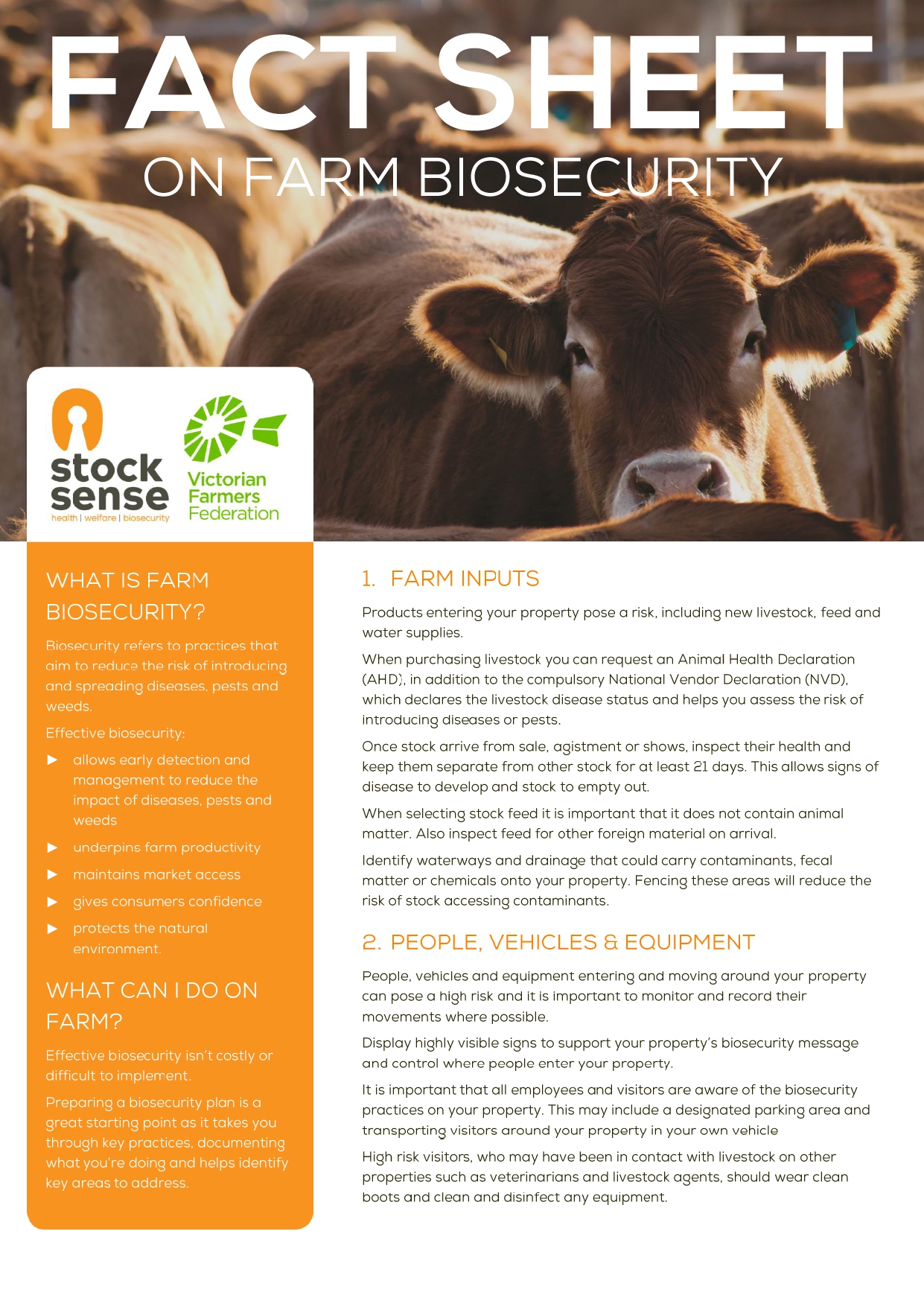
What is farm biosecurity and why it’s important for farmers.
If you’re feeling confused by all the acronyms, dates and biosecurity plan templates, you’re not alone! We’re here to help you sort through the information and help you make the best decision for your farm.
What is LPA and am I registered?
If you use NVDs you are part of the LPA program. Check your NVD book for the LPA logo.
LPA is the red meat industry’s Livestock Production Assurance program.
Being accredited means you agree to abide by the seven LPA rules and standards, a commitment to undertake specific practices that mean Australian red meat is safely and ethically produced. It guarantees that you stand by what you sell.
The Integrity Systems Company, an MLA subsidiary, administers the LPA program on behalf of industry and AUS-MEAT conducts the LPA farm audits.
From the 1 October 2017:
Two new modules were added to the existing LPA rules and standards: biosecurity and animal welfare. You should familiarise yourself with the requirements, and ensure you have a farm biosecurity plan in place to meet the requirements of the biosecurity module.
If you are LPA accredited this will involve completing a short assessment and paying a small fee, and then renewing your accreditation every three years thereafter. You will be notified two months before your re-accreditation is due with instructions.
To join LPA, you will need to complete a short assessment and pay a fee, and renew your accreditation every three years.
Online leaning modules are available to help producers understand their LPA obligations and prepare for the assessment.
Free eNVDs are available
Getting your farm records in order can be daunting and often getting started is the hardest part. Here are some helpful tools, supplied by Farm Biosecurity, to get your record keeping on-track. Remember that whatever format you choose, make it work for you and your enterprise.
Visitor Register Template (PDF) – Record the details of those entering your property and the risk they pose of introducing or spreading disease, pests and weeds.
JBAS is a voluntary, market-driven risk assessment tool implemented by industry through Cattle Council Australia and Animal Health Australia. The J-BAS System (PDF) uses scores from 0 to 8 to assess risk of exposure and management of Johne’s disease.
If you choose to participate in the program:
The default position for beef only producers after 30 June 2017 is JBAS 6, unless you have had a Johne’s disease infection on your property in the last 5 years in which case you should self-assess your JBAS.
Herds which were not beef only, have no previous infection of JD on their property and have implemented a biosecurity plan will have a score of 4.
Producers who held a transition score 7 or 8 can retain a score 7 by having a vet certified biosecurity plan and undertaking a check test with clear results by 1st July 2018.
A biosecurity plan that includes Johne’s disease specific practices is required for a JBAS 2 or higher. The same template can be used for LPA renewal; however, the Johne’s disease section is optional for LPA.
A minimum JBAS is only required for cattle travelling to WA or the NT.
This bushfire response information is designed to help you make practical decisions about looking after and managing your livestock, focusing on the steps after the immediate response.
It is important to look after yourself and your family in the immediate aftermath of an emergency. Look out for your neighbours and friends and makes sure they are coping as well.
If livestock are injured during a fire, seek help immediately from the local departmental staff or your livestock veterinarian.
Farmers wishing to report livestock impacted by fire should contactAgriculture Victoria on 03 53366721.
It is best to seek professional help as soon as possible to minimise the suffering of unsalvageable animals and reduce the unnecessary destruction of animals that can survive with some nursing.
If help is not at hand and for those who are experienced with firearms and euthanising stock, consider putting animals down that are unconscious, unable to rise or are displaying signs of severe respiratory distress. It is important to keep accurate records, such as photos, of destruction for insurance purposes and have them verified by an independent third party.
The following resources provide information about assessing and managing stock after a fire:
It is important to dispose of dead stock in a manner that is not going to cause future problems with contamination of waterways or aquifers and to prevent scavenging. This is usually coordinated by local council authorities and Agriculture Victoria staff for farm burials the following link gives useful guidelines.
Dairy Australia provides a range of tools to help you organise tasks immediately after a natural disaster including a ‘Recovery priority checklist’ and milking through power outages.
Treat returning stock as you would any new stock or stock returning from agistment according to your biosecurity plan. They are a risk of bringing disease and pests onto your farm. Stray stock from neighbours can also be a biosecurity threat. If possible, keep them separate from your stock and record tags.
PIC numbers can help in identifying where animals originated, and Agriculture Victoria can help you trace ownership.
It is important to consider how you are going to keep animals fed and watered in the medium-term. It is a good idea to seek help in this situation with feed budgets, cash flow and the return of the property to productivity. If needing to re-fence, use it as an opportunity to decide about redesigning paddocks, laneways and quarantine or stock introduction areas.
The options for dealing with limited feed-on-offer are agistment, buying in feed where required, selling stock and emergency slaughter. Emergency slaughter for affected animals is a possibility but is usually logistically difficult and most abattoirs are not interested or are running to capacity with other stock. Decisions on emergency slaughter should consider welfare as a priority.
Bringing in fodder brings with it risks of introducing weeds, pests and chemical contaminants or residues. You should always ask for a Commodity Vendor Declaration and feed out in narrow and well-defined areas so it is easier to monitor emergence and control, weeds after the autumn break.
Feeding to keep animals alive will follow the same procedure as you would in a drought feeding situation. Use of a containment areas or sacrifice paddocks is important to allow recovery, control of weeds and management of animals during the time pastures and farm infrastructure is returned to something approaching normal. Agriculture Victoria has developed specific information about feeding livestock when feed is limited.
It is important to supply water of sufficient quality and quantity in the immediate and longer-term after a fire. Dams can become heavily polluted after fire when rain causes excessive runoff of ash and other organic matter. You can reduce this reducing this risk with sediment fencing.
For more information on water in the recovery period visit:
Agistment can be a convenient solution to overcome short to medium term feed deficits. It is important to consider any biosecurity risk, have a clear understanding and written agreements on responsibilities for care, feeding and return of stock with the landowner BEFORE moving stock.
The recovery of fire affected pastures will depend on a number of factors: type of pasture, stage of growth, follow-up rain and heat of the fire. It is important to assess this reasonably accurately to allow decisions on whether to resow or not. Seek help from an agronomist where needed. For a quick guide on pasture recovery after fire:
The VFF was built by farmers and only succeeds through strength in numbers. Sign up today to take advantage of farmer-led advocacy, advice and benefits.